

Every time you take a shower, wash your hands or run the washing machine, water flows down the drain. But could some of that water be reused to keep your garden healthy?
For Perth homeowners looking for practical ways to manage water consumption, greywater systems offer an alternative source of water for garden irrigation.
Instead of sending all household wastewater directly to the sewer, a suitable greywater system can redirect certain types of used water to lawns and garden beds.
However, greywater reuse isn’t as simple as connecting a household drain to your existing sprinklers. The water source, irrigation method, system design and Western Australian regulations all matter.
So, how do greywater systems work, what are their benefits, and can you use one in your Perth garden?
1. What Is Greywater?
Greywater is wastewater generated from household activities that do not involve toilet waste.
Common sources include:
- Showers
- Baths
- Bathroom hand basins
- Washing machines
- Laundry troughs
Greywater may contain soap, detergent, dirt, hair, skin particles and other household residues.
Although it has already been used, some greywater can be reused for irrigation when managed through an appropriate system.
What Is the Difference Between Greywater and Blackwater
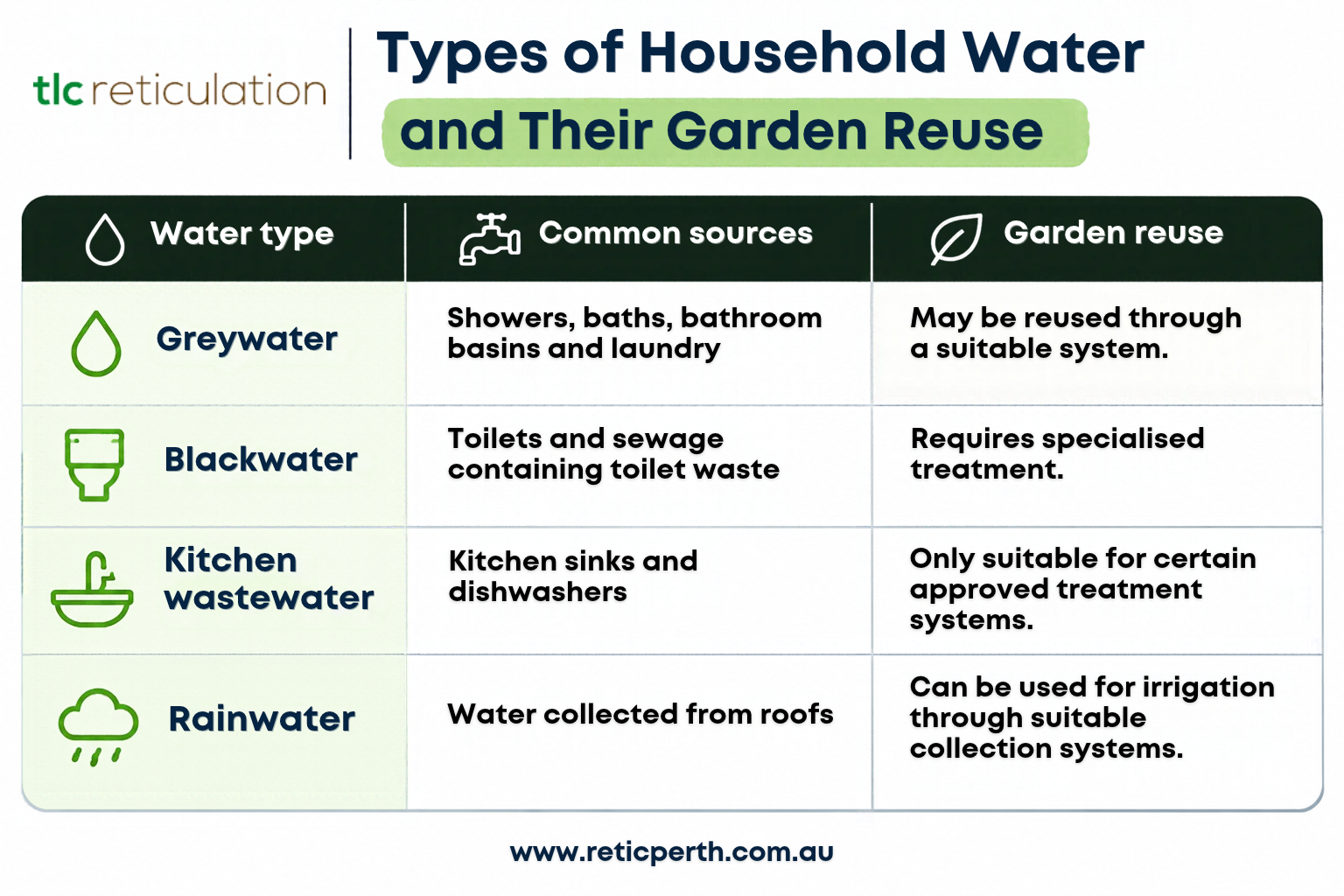
Not all household wastewater can be reused in the same way.
| Water type | Common sources | Garden reuse |
| Greywater | Showers, baths, bathroom basins and laundry | May be reused through a suitable system |
| Blackwater | Toilets and sewage containing toilet waste | Requires specialised treatment |
| Kitchen wastewater | Kitchen sinks and dishwashers | Only suitable for certain approved treatment systems |
| Rainwater | Water collected from roofs | Can be used for irrigation through suitable collection systems |
Kitchen wastewater is often excluded from simple greywater systems because it may contain grease, food particles and higher levels of contamination.
In Western Australia, the Department of Health distinguishes between greywater diversion devices and treatment systems, with different requirements for each.
2. How Do Greywater Systems Work?
A greywater system collects wastewater from selected household fixtures and redirects it for an approved reuse purpose.
For garden irrigation, the system typically involves three main stages.
Step 1: Collect Greywater From Suitable Household Sources
Greywater is collected from selected plumbing fixtures, such as a shower or washing machine.
The available amount depends on household occupancy and water-use habits.
For example, a household that regularly uses its washing machine may produce a different volume of greywater from a household with fewer occupants.
Not every water source is suitable for every system.
Step 2: Divert or Treat the Water
Depending on the system, greywater may be diverted directly to an appropriate irrigation area or treated before reuse.
Western Australia recognises two main system categories.
Greywater diversion devices (GDDs) redirect untreated greywater to a suitable subsurface irrigation system. They include a means of directing water back to the sewer when garden reuse is not appropriate.
Greywater treatment systems (GTSs) treat greywater to a higher standard. The permitted uses depend on the system’s approval, treatment performance and whether disinfection is included.
Step 3: Distribute Greywater to the Garden
Greywater can be distributed through an approved irrigation system.
For untreated greywater from a diversion device, Western Australian requirements specify subsurface irrigation.
This means the water is applied beneath the soil surface rather than sprayed into the air.
Subsurface distribution helps reduce direct contact with untreated wastewater.
Not all conventional sprinkler or drip irrigation components are suitable for greywater. The irrigation system must be designed for the water quality and relevant approval requirements.
3. Five Benefits of Greywater Systems for Perth Homes
Greywater reuse can provide several practical benefits when the system is correctly designed, installed and maintained.
1. Reduce Reliance on Scheme Water for Garden Irrigation
Many Perth gardens rely on scheme water for irrigation.
A greywater system can provide an alternative source of water for suitable garden areas.
For example, water from a shower or washing machine that would otherwise enter the sewer may be redirected to an approved subsurface irrigation area.
This can reduce the amount of potable water required for certain outdoor watering activities.
The actual reduction depends on household water use, garden requirements and how much greywater can be reused safely.
2. Make Better Use of Household Water
Greywater systems allow households to use certain water supplies more than once.
Instead of treating all used water as waste, a suitable system can redirect part of it to support garden irrigation.
This can be particularly useful for households interested in reducing unnecessary water consumption.
However, greywater reuse should match the garden’s actual watering requirements. Producing more greywater does not mean the garden should receive more water.
3. Provide an Additional Water Source During Dry Conditions
Perth experiences hot, dry summers when garden irrigation can become particularly important.
Households continue generating greywater through everyday activities such as showering and washing clothes.
A suitable reuse system can make part of this water available for irrigation.
However, the volume of greywater produced may not be sufficient to meet all garden watering requirements.
Greywater should be considered a supplementary source rather than a guaranteed replacement for conventional irrigation.
4. Support More Sustainable Household Water Management
Reusing household water can help reduce demand for potable water supplies.
It also encourages homeowners to consider how water is used throughout the property.
For example, combining suitable greywater reuse with efficient irrigation practices may help reduce unnecessary consumption.
These practices include:
- Repairing leaking irrigation pipes
- Maintaining sprinkler and irrigation components
- Adjusting watering schedules
- Improving irrigation coverage
- Selecting appropriate plants for local conditions
A greywater system works best as part of a broader approach to water efficiency.
5. Potentially Reduce Household Water Costs
For properties connected to scheme water, reducing potable water use may lower water consumption charges.
However, the financial benefit of a greywater system depends on several factors.
These include:
- Installation costs
- Household greywater production
- Garden irrigation requirements
- Maintenance expenses
- Pump electricity consumption, where applicable
- The amount of scheme water replaced
A greywater system should not be assumed to pay for itself within a particular period without a property-specific assessment.
4. Can Greywater Be Used With an Existing Reticulation System?
This is an important question for homeowners who already have a sprinkler or drip irrigation system.
Greywater cannot simply be connected to an existing reticulation system without checking its suitability.
Traditional reticulation systems are commonly designed to distribute scheme water or bore water.
Greywater has different characteristics because it may contain soap residues, suspended particles, organic matter and microorganisms.
These can affect irrigation components and create health risks if the system is not designed appropriately.
Greywater Irrigation vs Traditional Reticulation
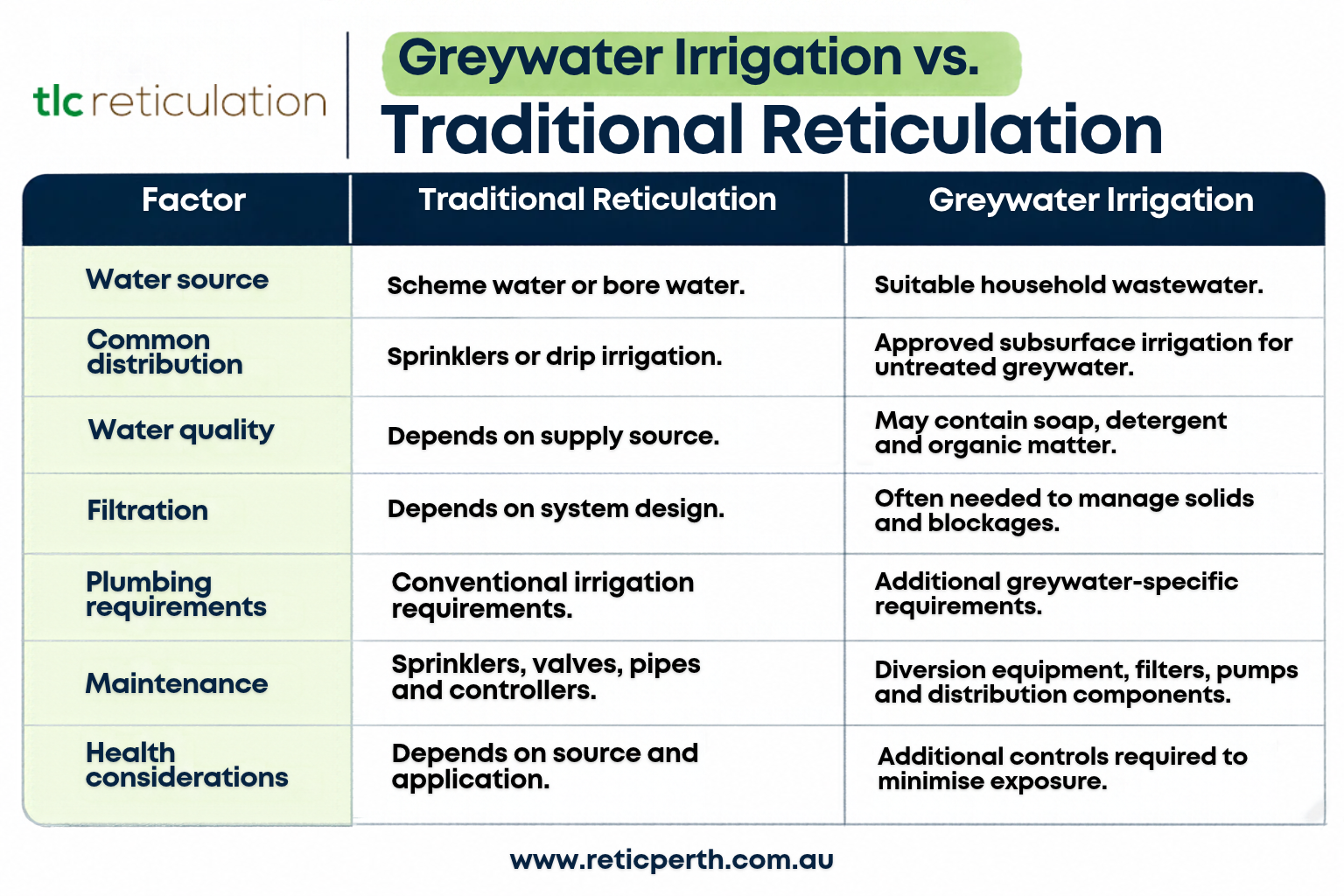
| Factor | Traditional reticulation | Greywater irrigation |
| Water source | Scheme water or bore water | Suitable household wastewater |
| Common distribution | Sprinklers or drip irrigation | Approved subsurface irrigation for untreated greywater |
| Water quality | Depends on supply source | May contain soap, detergent and organic matter |
| Filtration | Depends on system design | Often needed to manage solids and blockages |
| Plumbing requirements | Conventional irrigation requirements | Additional greywater-specific requirements |
| Maintenance | Sprinklers, valves, pipes and controllers | Diversion equipment, filters, pumps and distribution components |
| Health considerations | Depends on source and application | Additional controls required to minimise exposure |
5. What Are the Rules for Greywater Systems in Perth?
Greywater reuse in Western Australia is regulated under the Code of Practice for the Reuse of Greywater in Western Australia 2010 and relevant health and plumbing requirements.
Homeowners should understand these requirements before purchasing or installing a system.
Do Greywater Systems Need Council Approval?
The answer depends on the system type.
| Greywater reuse method | General WA approval requirements |
| Manual bucketing | Generally does not require system approval, but safe-use guidance applies |
| Compliant greywater diversion device | Local government approval generally not required when the applicable exemption conditions are met |
| Greywater treatment system | Approval and a permit to use are generally required |
| Larger or more complex reuse schemes | Additional assessment and approvals may apply |
Greywater diversion devices must meet applicable WaterMark certification and plumbing requirements.
Treatment systems must be approved for their intended use, and installation approval must be obtained where required.
The system must also comply with relevant plumbing standards and installation conditions.
Homeowners should consult the WA Department of Health’s greywater guidance and their local government Environmental Health Officer before proceeding.
Frequently Asked Questions About Greywater Systems in Perth
1. Can I use shower water to water my garden?
Yes, shower water can be reused for garden irrigation through an appropriate greywater system. Untreated greywater from a diversion device must be applied through compliant subsurface irrigation.
2. Can washing machine water be used for garden irrigation?
Yes, suitable laundry greywater can be reused through an appropriate system. However, detergents and cleaning products can affect soil and plants, so product selection and system design are important.
3. Can I connect greywater directly to my sprinklers?
Not without assessing the system and legal requirements. Untreated greywater from a diversion device must not be distributed through ordinary above-ground sprinklers in Western Australia.
4. Is greywater safe for lawns and garden beds?
Greywater can be suitable for certain lawns and garden beds when applied through a compliant system. Water quality, soil conditions, plant selection and irrigation method must all be considered.
5. Do greywater systems need a filter?
Many greywater systems include filtration or other components to manage solids. The exact requirements depend on the system type and manufacturer specifications.
6. How much water can a greywater system save?
Savings vary according to household water production, garden demand and system design. Water Corporation has documented a Perth Hills example where greywater irrigation saved approximately 114,000 litres annually for a 100-square-metre garden, but this is a specific case study rather than a typical household result.
7. Can greywater be used during Perth’s winter sprinkler switch-off?
Greywater reuse has different requirements from conventional scheme-water and bore-water sprinkler irrigation. Whether a particular system can operate depends on its design and applicable rules. Check the relevant requirements before use.
8. Do I need a plumber to install a greywater system?
Plumbing connections and regulated installation work must be completed by appropriately licensed professionals. Additional approval requirements depend on the system type.
9. Can greywater damage plants?
Yes. Excessive application, unsuitable detergents, salts and other substances can affect soil and plant health. Correct system design and appropriate household products help reduce these risks.
10. Are greywater systems expensive to maintain?
Maintenance costs depend on the system. Simple diversion devices may have fewer components than treatment systems, while systems with pumps, filters and treatment equipment may require more extensive servicing.
Planning a More Water-Efficient Garden in Perth?
Greywater systems offer Perth homeowners another way to make use of household water.
When correctly designed and maintained, they can provide an additional irrigation source while reducing reliance on potable water for suitable garden areas.
However, greywater reuse requires careful consideration of water quality, soil conditions, plumbing and Western Australian health regulations.
Before installing a system, confirm that the proposed equipment and irrigation method are appropriate for your property.
TLC Reticulation provides reticulation repairs, maintenance and irrigation controller services across Perth.
If you’re reviewing your existing garden irrigation system, our team can assist with conventional reticulation fault finding, sprinkler repairs and controller requirements.
For greywater-specific installation, seek advice from a suitably qualified provider and confirm the necessary approvals.
Phone: 0431 248 007
Website: Contact TLC Reticulation