

Is your reticulation system watering your lawn properly, or could an unnoticed fault be wasting water beneath the surface?
A sprinkler that barely sprays, a wet patch that never dries or a controller that suddenly stops working may seem like minor problems. However, these issues can indicate damaged pipes, faulty valves, wiring problems or an irrigation system that is no longer operating efficiently.
In Perth, where lawns and gardens depend on reliable irrigation during hot, dry conditions, identifying these problems early can help prevent unnecessary water loss and damage to your landscaping.
At TLC Reticulation, we provide professional reticulation repairs, fault finding, servicing and irrigation system upgrades across Perth. Our services cover underground pipe leaks, sprinkler faults, solenoid valves, controller problems and bore-related irrigation issues.
This guide explains seven warning signs that your reticulation system needs attention, what may be causing them and when professional repairs or a system upgrade may be appropriate.
1. What Are the 7 Warning Signs Your Reticulation System Needs Repairs?
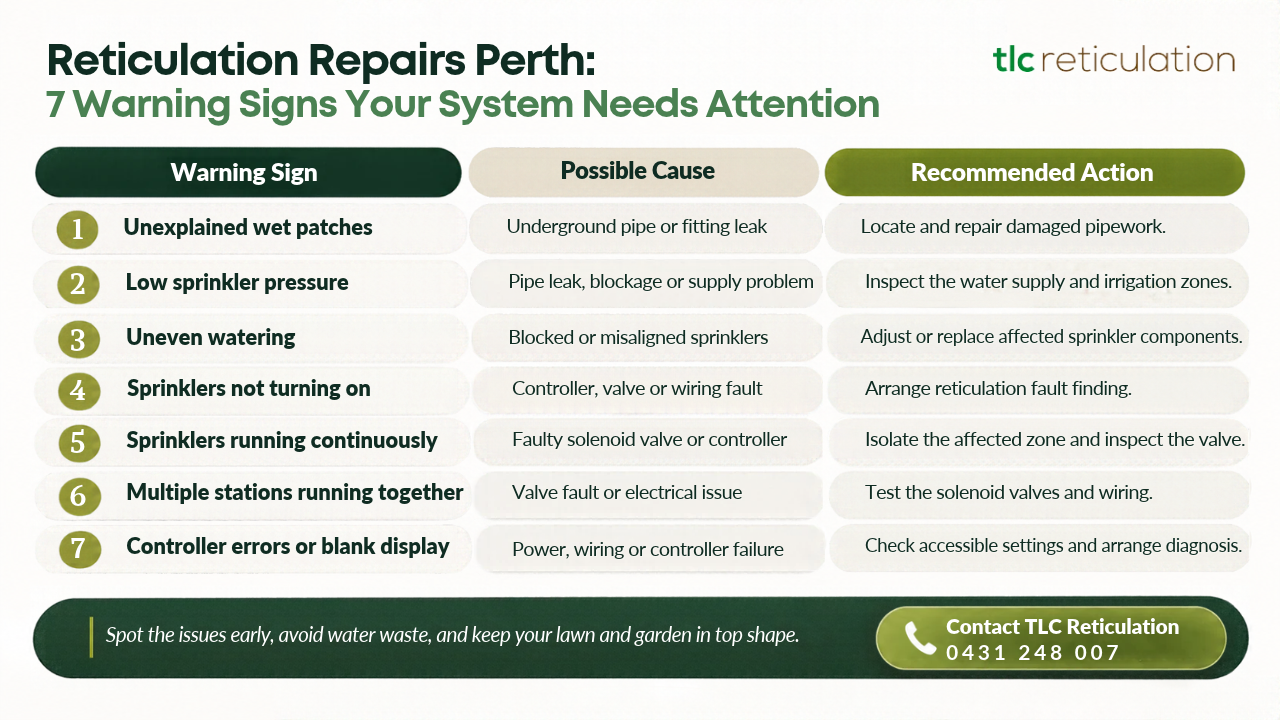
A reticulation system may need repairs if sprinklers stop working, water pressure drops, wet patches appear, watering becomes uneven or the controller operates incorrectly.
The table below summarises seven common warning signs and their possible causes.
| Warning sign | Possible cause | Recommended action |
| 1. Unexplained wet patches | Underground pipe or fitting leak | Locate and repair damaged pipework |
| 2. Low sprinkler pressure | Pipe leak, blockage or supply problem | Inspect the water supply and irrigation zones |
| 3. Uneven watering | Blocked or misaligned sprinklers | Adjust or replace affected sprinkler components |
| 4. Sprinklers not turning on | Controller, valve or wiring fault | Arrange reticulation fault finding |
| 5. Sprinklers running continuously | Faulty solenoid valve or controller | Isolate the affected zone and inspect the valve |
| 6. Multiple stations running together | Valve fault or electrical issue | Test the solenoid valves and wiring |
| 7. Controller errors or blank display | Power, wiring or controller failure | Check accessible settings and arrange diagnosis |
Not every symptom means the entire system needs replacing. Many faults can be resolved by repairing or replacing individual components.
Warning Sign 1: Unexplained Wet Patches or Water Pooling
Have you noticed a section of your lawn that stays wet even when the sprinklers are switched off?
Persistent wet patches can indicate an underground reticulation leak.
Reticulation pipes and fittings can become damaged through ground movement, landscaping work, excavation or general deterioration.
Common signs of an underground reticulation leak include:
- Water pooling around sprinkler heads or garden beds
- Unusually soft or muddy soil
- Water escaping near underground fittings
- Reduced pressure in nearby sprinklers
- Unexpectedly high water consumption
A leaking pipe may continue losing water beneath the surface without producing an obvious spray or visible break.
Recommended action: Turn off the affected irrigation zone or water supply where practical. TLC Reticulation can locate and repair damaged underground pipes and fittings.
For more information about leak detection and repairs, visit our Reticulation Repairs page.
Warning Sign 2: Low Water Pressure From Your Sprinklers
Why are your reticulation sprinklers suddenly producing less water?
Low sprinkler pressure can affect how far water travels and whether the intended lawn or garden area receives adequate coverage.
Possible causes include:
- Leaking underground pipes
- Blocked sprinkler nozzles
- Faulty or partially opening valves
- Problems with the water supply
- Excessive demand from too many sprinklers operating together
- Bore pump or pressure problems in bore-fed systems
A single weak sprinkler may indicate a local blockage or damaged component. If several sprinklers in the same zone lose pressure, the problem may involve the valve, pipework or water supply.
Recommended action: Check whether the issue affects one sprinkler, one irrigation zone or the entire system. TLC Reticulation can investigate pressure loss and identify the components requiring attention.
For bore-fed systems, pressure problems may also be associated with the pump. See our Bore Installation and Repairs services.
Warning Sign 3: Uneven Watering and Dry Patches
A healthy lawn should receive reasonably consistent irrigation across the areas intended to be watered.
If one section remains green while another becomes dry, the issue may be related to sprinkler coverage rather than insufficient watering time.
Common causes of uneven watering include:
- Blocked sprinkler nozzles
- Incorrect sprinkler positioning
- Damaged or sunken sprinkler heads
- Mismatched sprinkler types
- Inadequate pressure
- Poor irrigation zone design
For example, a sprinkler that has shifted out of position may spray towards a pathway instead of the lawn. A blocked nozzle may prevent water from reaching the far side of a garden bed.
Increasing the watering duration without correcting these problems may waste water while leaving the affected area dry.
Recommended action: Inspect sprinkler coverage and check for visible damage or blockages. TLC Reticulation can adjust sprinkler positioning, replace damaged heads and service the system to improve water distribution.
Warning Sign 4: Your Reticulation System Will Not Turn On
If your irrigation controller indicates that watering should be running but no sprinklers activate, there may be a problem with the controller, solenoid valve, wiring or water supply.
Possible causes include:
- Incorrect watering schedules
- Controller set to OFF or rain-delay mode
- Failed solenoid valve
- Damaged underground field wiring
- Faulty master valve
- Interrupted water supply
- Controller power failure
If only one zone fails, the issue may be isolated to that station’s valve or wiring.
If the entire system fails to operate, the controller, master valve or main water supply may need investigation.
Recommended action: Check the controller’s visible settings and confirm the water supply is available. If the problem continues, contact TLC Reticulation for professional reticulation fault finding in Perth.
Do not open electrical enclosures or attempt to repair hardwired equipment yourself. Electrical work must be completed by an appropriately licensed electrician.
Warning Sign 5: Sprinklers Continue Running After the Controller Switches Off
Your watering cycle has finished, so why are the sprinklers still running?
Sprinklers that continue operating after their scheduled cycle may indicate a valve that is not closing correctly.
Solenoid valves regulate water flow to individual irrigation zones. When a valve becomes damaged or obstructed, water may continue passing through even after the controller stops sending an activation signal.
Possible causes include:
- Debris inside the valve
- Damaged valve diaphragm
- Worn internal components
- Incorrect manual valve settings
- Controller or electrical faults
Continuous watering can lead to water pooling, oversaturated soil and unnecessary water consumption.
Recommended action: Shut off the affected irrigation supply if safe and practical. TLC Reticulation can locate buried solenoid valves using electronic locating equipment and replace faulty components.
Warning Sign 6: Multiple Reticulation Stations Turn On at the Same Time
Most automatic irrigation systems divide the property into separate watering zones.
Each zone is designed to operate according to the programmed schedule and available water pressure.
If multiple stations activate unexpectedly, the system may experience reduced pressure or uneven watering.
Possible causes include:
- A solenoid valve stuck open
- Damaged valve components
- Incorrect controller programming
- Wiring faults
- An issue with the master valve or station connections
Operating multiple zones unintentionally can place additional demand on the water supply and reduce sprinkler performance.
Recommended action: Check the programmed watering times for overlapping schedules. If the settings are correct, arrange professional valve and wiring inspection.
TLC Reticulation can locate and replace faulty solenoid valves and diagnose damaged irrigation wiring.
Warning Sign 7: Your Reticulation Controller Displays Errors or Goes Blank
Your irrigation controller is responsible for managing watering schedules and activating individual zones.
When the controller fails, the entire irrigation system may become unreliable.
Common warning signs include:
- Blank controller display
- Repeated error messages
- Watering programmes failing to start
- Zones activating unexpectedly
- Controller settings being lost
- Repeated electrical fault indications
A blank screen may be related to the power supply, backup battery or controller failure.
Repeated electrical errors can indicate damaged field wiring or a faulty solenoid coil.
Recommended action: Check the controller’s accessible display, settings and power indicators. If the fault persists, TLC Reticulation can diagnose the system and recommend suitable repairs or a controller replacement.
For replacement options, see our Reticulation Controllers page.
Reticulation Repairs or Installation: Which Is the Better Option?
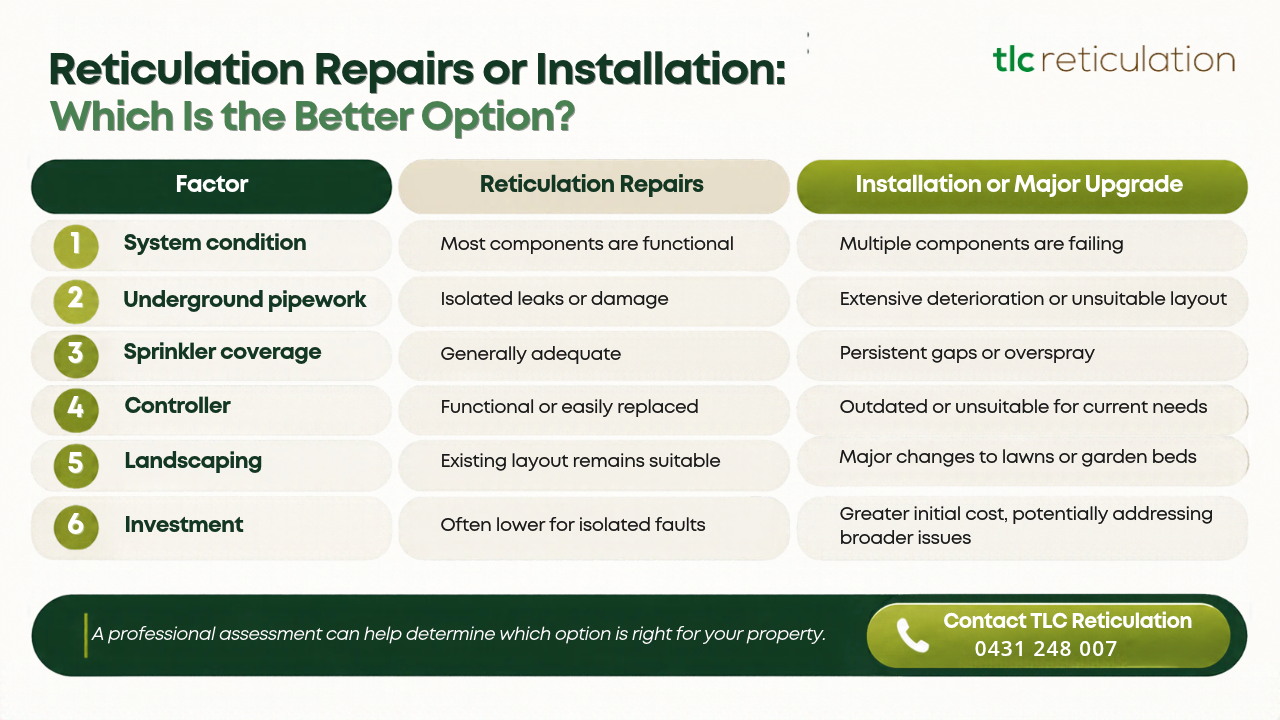
Not every irrigation fault requires a completely new system.
In many cases, repairing an underground pipe, replacing a sprinkler head or installing a new controller can restore reliable operation.
However, an older reticulation system with recurring leaks, widespread component failure or inadequate coverage may benefit from substantial upgrades or replacement.
| Factor | Reticulation repairs | Installation or major upgrade |
| System condition | Most components are functional | Multiple components are failing |
| Underground pipework | Isolated leaks or damage | Extensive deterioration or unsuitable layout |
| Sprinkler coverage | Generally adequate | Persistent gaps or overspray |
| Controller | Functional or easily replaced | Outdated or unsuitable for current needs |
| Landscaping | Existing layout remains suitable | Major changes to lawns or garden beds |
| Investment | Often lower for isolated faults | Greater initial cost, potentially addressing broader issues |
When Should You Repair Your Existing Reticulation System?
Repairs are usually worth considering when the system is generally functional and the problem is limited to a particular component.
For example, replacing one faulty solenoid valve may be more practical than replacing an otherwise functional irrigation network.
When Should You Consider a New Reticulation Installation?
Installation or major upgrades may be appropriate when:
- The property does not have an existing irrigation system.
- Landscaping changes require a different sprinkler layout.
- Multiple underground pipes are deteriorating.
- Existing zones cannot provide adequate coverage.
- Repeated repairs are becoming costly.
- The system needs significant improvements to support current watering requirements.
A professional assessment can help determine which option is suitable.
TLC Reticulation provides repairs, servicing and system upgrades, including more extensive reticulation work where required.
Why Does TLC Reticulation Use Hunter Irrigation Products?
The quality and suitability of irrigation components can influence system reliability, maintenance requirements and watering performance.
TLC Reticulation uses quality products from established irrigation manufacturers, including Hunter controllers and sprinklers.
Hunter offers irrigation products designed for different residential and commercial applications.
How Much Do Reticulation Repairs Cost in Perth?
Reticulation repair costs depend on the fault, equipment accessibility, replacement parts and labour required.
TLC Reticulation’s published repair service rates include a $99 call-out fee (incl. GST), with labour starting from $33 per 15 minutes (incl. GST).
The Repairs page also provides indicative costs for selected services.
| Repair service | Indicative cost |
| Broken pipe or sprinkler repair | Approximately $200 |
| Faulty solenoid valve replacement | Approximately $300-$400 |
| Certain wiring or controller electrical faults | Approximately $300-$400 |
| Controller supply, fitting and testing | From $500 |
These are published estimates, not guaranteed quotations. Actual costs depend on the fault, site conditions, required parts and scope of work.
For example, an underground valve located beneath paving or difficult ground conditions may require additional labour.
TLC Reticulation can inspect the system, identify the fault and advise on the repairs required.
Visit our Reticulation Repairs page for service details.
Reticulation Repairs and Installation Services Across Perth
TLC Reticulation provides professional reticulation repairs, fault finding, servicing and irrigation system upgrades across Perth.
Our services include:
- Underground reticulation pipe repairs
- Sprinkler head repairs and replacement
- Solenoid valve locating and replacement
- Reticulation wiring fault finding
- Irrigation controller installation
- Hunter controller upgrades
- Hydrawise-compatible controller setup
- Irrigation system servicing
- Bore pump and irrigation-related repairs
Reticulation Services in Joondalup and Surrounding Perth Suburbs
TLC Reticulation assists property owners across Perth, including enquiries from Joondalup and surrounding northern suburbs.
Customers in areas such as Wanneroo, Woodvale, Kingsley, Duncraig, Greenwood and Hillarys can contact TLC to confirm service availability for their property.
Whether your system has a damaged sprinkler, an underground leak or an outdated controller, our team can help identify the appropriate repair or upgrade.
Frequently Asked Questions About Reticulation Repairs in Perth
1. What are the most common reticulation problems in Perth?
Common problems include leaking underground pipes, broken sprinklers, faulty solenoid valves, damaged wiring, controller failures and uneven water pressure. The appropriate repair depends on the underlying cause.
2. How do I know if my reticulation system has an underground leak?
Possible signs include persistent wet patches, pooling water, reduced sprinkler pressure and unexplained water consumption. Professional fault finding can help locate leaks that are not visible at the surface.
3. Why are my reticulation sprinklers not turning on?
Sprinklers may fail to operate because of incorrect controller settings, faulty valves, damaged wiring or interrupted water supply. If basic controller checks do not resolve the issue, professional diagnosis is recommended.
4. Can an old reticulation system be repaired?
Yes. Many older systems can be repaired by replacing damaged pipes, valves, sprinklers or controllers. However, systems with widespread deterioration or unsuitable layouts may benefit from more extensive upgrades.
5. How much do reticulation repairs cost in Perth?
TLC Reticulation’s published service rates include a $99 call-out fee, with labour starting from $30 per 15 minutes. The total cost depends on the type of fault, required parts and labour. TLC also publishes indicative pricing for selected common repairs.
6. Does TLC Reticulation install Hunter irrigation controllers?
Yes. TLC Reticulation supplies and installs Hunter irrigation controllers and can assist with selecting suitable controller options for existing systems.
7. Can I control my reticulation system using my phone?
Yes, with a compatible smart irrigation controller. Hunter Hydrawise allows supported controllers to be managed through a mobile app or web browser when correctly configured and connected.
8. Does Hydrawise detect underground irrigation leaks?
Hydrawise can support flow monitoring and related alerts when compatible monitoring equipment is installed. It does not automatically detect every underground leak, and physical inspection may still be required.
9. Should I repair or replace my reticulation system?
Repair is often suitable for isolated faults when the rest of the system remains functional. Replacement or major upgrades may be more appropriate when there are recurring failures, widespread pipe damage or significant coverage problems.
10. How often should reticulation systems be serviced?
An annual inspection is a practical general recommendation. Systems experiencing leaks, poor sprinkler coverage or repeated controller faults should be checked sooner.
Reticulation Problems? Contact TLC Reticulation in Perth
A damaged sprinkler or leaking underground pipe may appear minor, but unresolved irrigation faults can affect your lawn, increase water consumption and reduce the performance of your entire system.
TLC Reticulation provides professional reticulation repairs, fault finding, maintenance and controller upgrades across Perth.
Our team works with quality irrigation components, including Hunter products and compatible Hydrawise smart controllers, to help maintain reliable watering systems.
Book a reticulation inspection or repair with TLC Reticulation.
Call: 0431 248 007
Contact: TLC Reticulation